Bitcoin — Between Institutional Maturity and Macroeconomic Stress Test
Date: April 20, 2026 | Current Price: $74,372.79 | Change: +0.75% | Ticker: BTC/USD
The Asset in Context
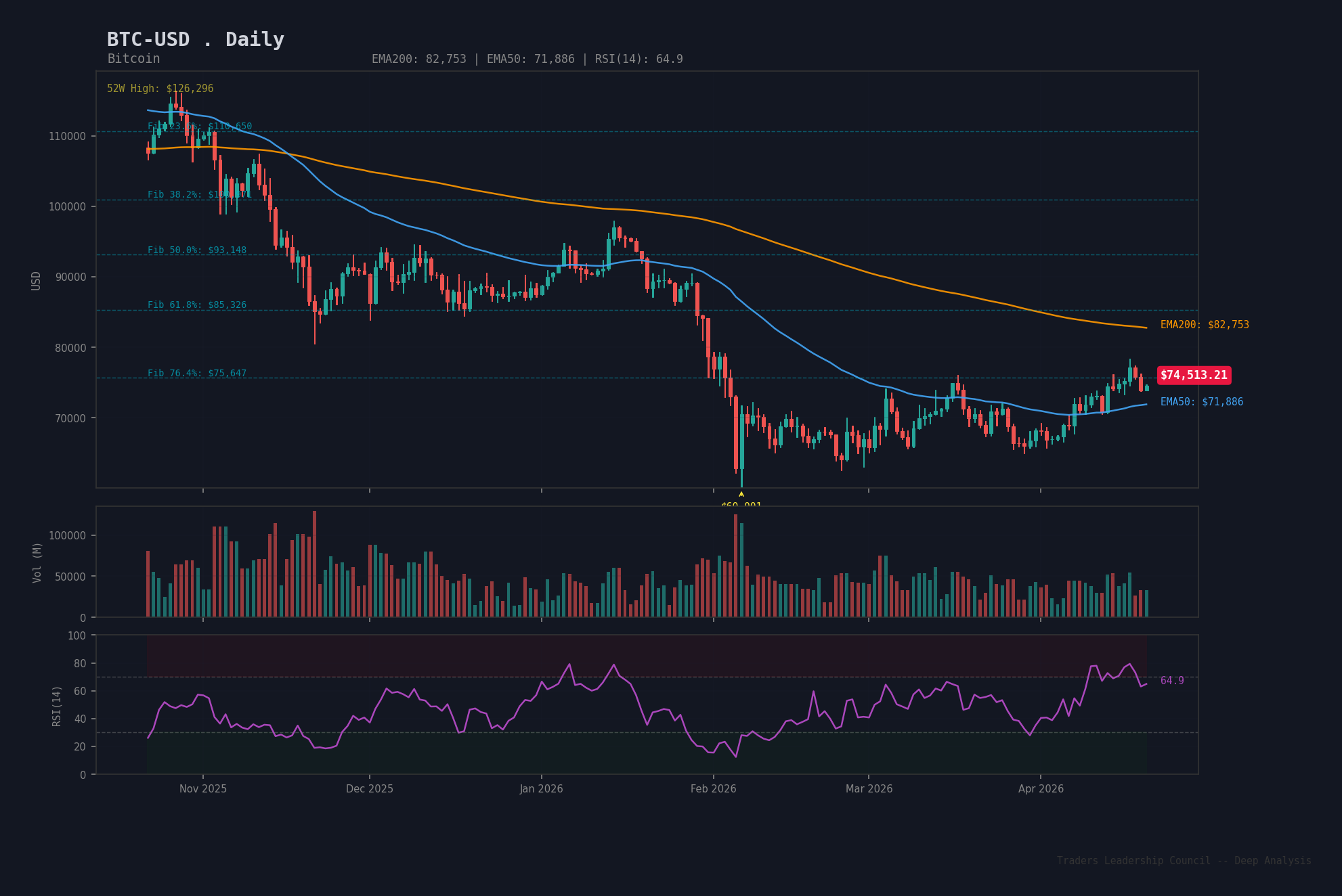
Bitcoin trades at $74,372.79 at time of writing, navigating a technically sensitive corridor: well below the all-time high of $126,296 recorded on October 6, 2025, yet meaningfully recovered from the year’s trough of $60,001 (February 6, 2026). The recent recovery above the $75,000 threshold was driven principally by institutional demand, evidenced by record spot ETF inflows of $18.7 billion in the first quarter of 2026 alone. Bitcoin has completed its structural transformation from speculative niche instrument to legitimate institutional asset class — a shift whose full implications the market continues to price in. The network’s post-halving supply mechanics, combined with the gravitational pull of corporate treasury accumulation, have fundamentally altered the balance between newly issued supply and persistent institutional demand.
Macro Forces at Play
The macroeconomic backdrop for Bitcoin is ambivalent but directionally constructive. The Federal Reserve holds its benchmark rate in the 3.50–3.75 percent corridor, having navigated a sequence of tightening cycles that weighed on risk assets through 2023 and 2024. US core inflation, according to the Bureau of Labor Statistics, stands at 2.6 percent as of March 2026, while headline inflation is being compressed by declining oil prices following the US-Iran ceasefire. Services inflation remains persistent at 3.1 percent, preventing the Fed from pivoting decisively, yet it continues to fan rate-cut expectations in markets that are acutely sensitive to shifts in monetary guidance.
The US Dollar Index above 100 exerts short-term headwinds on Bitcoin as an inversely correlated asset, though it simultaneously underscores a flight to perceived stores of value — a category in which Bitcoin now competes directly with gold, which itself trades at all-time highs. US GDP growth remains moderate, with government spending contributing negatively to the growth rate in the most recent quarter while private investment provided modest support. Producer price inflation of 0.5 percent month-on-month signals that pipeline price pressures have not fully dissipated, complicating the Fed’s decision calculus. Historically, Bitcoin has demonstrated strong positive performance in rate-cut environments as capital rotates from fixed income into alternative assets — a dynamic the market is already partially discounting.
Supply, Demand and Market Structure
Bitcoin’s supply regime underwent a fundamental shift after the 2024 halving, which reduced daily coin issuance by half and pushed the network’s annual inflation rate below one percent — below every major fiat currency. At the same time, institutional investors and corporate treasuries, led by Strategy (formerly MicroStrategy), are permanently withdrawing millions of coins from circulating supply. BlackRock’s iShares Bitcoin Trust (IBIT) alone manages $54 billion in assets under management and absorbed approximately $8.4 billion in net inflows during Q1 2026, according to Intellectia AI. On April 17, 2026, US spot Bitcoin ETFs recorded net inflows of $663.9 million in a single trading day, as reported by KuCoin — a figure that underscores the durability of institutional appetite. Total US Bitcoin ETF flows since the start of 2026 amount to $23.6 billion, per Crypto Briefing, though gold ETFs retain a lead with $44.4 billion year-to-date. Bernstein maintains a $150,000 price target for 2026 with a $200,000 peak projected in 2027, premised on sustained institutional absorption of available supply, as CryptoSlate reports.
Geopolitics and Risk Landscape
The US-Iran ceasefire has provided a meaningful short-term de-risking of geopolitical tail risk, compressing risk premiums that had been embedded in energy and financial assets alike. Declining oil prices, a direct consequence of eased Middle Eastern tensions, are simultaneously suppressing inflationary pressures and reducing the political imperative for the Fed to maintain a hawkish stance — a feedback loop that fuels rate-cut expectations. This macro alignment catalyzed an estimated $427 million short-squeeze that meaningfully contributed to Bitcoin’s recovery above $75,000.
Yet geopolitical risk remains structurally elevated. A re-escalation in the Middle East, a fresh deterioration in US-China trade relations, or an unexpected acceleration in global inflation could rapidly shift risk appetite. Bitcoin, despite its growing institutional legitimacy, still exhibits higher volatility than traditional safe-haven assets in acute stress episodes. The regulatory environment in the United States has materially improved under the current administration, with a clear digital asset framework broadly regarded as politically achievable — a development that underpins long-term institutional adoption. In contrast, regulatory uncertainty across Europe and parts of Asia represents a persistent headwind to broader global capital allocation into the asset class.
Chart Analysis
Bitcoin occupies a technically critical zone. The 200-day EMA stands at $82,753 — approximately 11 percent above the current price — and acts as a powerful magnetic resistance level; a sustained break above it would meaningfully improve the medium-term technical picture. The 50-day EMA at $71,886 was recently reclaimed from below, a constructive short-term signal indicating recovering momentum. The RSI(14) reads 57.3 — firmly in neutral territory, neither overbought nor oversold — leaving room for further upside without triggering an immediate overheating warning.
Fibonacci retracement analysis from the all-time high at $126,296 (October 2025) to the cycle low at $60,001 (February 2026) reveals the 76.4 percent level at $75,647 as the immediate resistance zone the current rally is attempting to clear. The 61.8 percent retracement at $85,326 represents the next meaningful target, coinciding closely with the 200-day EMA. Immediate structural support is found near $62,535 (the 60-day low), while resistance is established at $78,390 (the 60-day high). The combination of a rising 50-day EMA and a neutral RSI suggests the path of least resistance is upward, subject to macro and regulatory catalysts.
Risk Factors
The most immediate macro risk is a re-acceleration of US inflation. Should oil prices reverse course — driven by geopolitical re-escalation or OPEC+ supply cuts — and push headline CPI materially higher, the Fed could postpone or abandon its rate-cut trajectory. A return to a more restrictive monetary regime would place direct downward pressure on Bitcoin as a risk asset and divert institutional capital back toward fixed income. This scenario would be particularly damaging given the elevated positioning that ETF inflows have created.
A second risk is technical in nature. The 200-day EMA at $82,753 represents a formidable resistance barrier. Repeated failures to sustain a breakout above this level could activate algorithmic sell signals and stop-loss cascades, as the market remains structurally below the highs set at $126,296 in October 2025. A failure at this resistance could open a retest of the $70,000 support zone or, in a stress scenario, the $62,535 structural low.
Regulatory risk outside the United States persists. Stricter capital requirements for banks holding crypto assets, adverse tax treatment in key European markets, or a crackdown on crypto exchanges in Asia could dampen institutional demand in markets that represent significant potential capital pools. China’s ongoing restrictions on cryptocurrency trading continue to exclude a large swathe of global liquidity from the market.
Finally, the concentration of institutional holdings creates a latent systemic risk. Were a major ETF sponsor or corporate treasury forced into compulsory liquidation — through regulatory action, balance sheet distress, or a broader market deleveraging — the resulting sell pressure could be disproportionate relative to the market’s underlying liquidity depth, a dynamic that has manifested in prior Bitcoin drawdown cycles.
Outlook and Key Dates
Bitcoin stands at a technical inflection point: a sustained daily close above $76,000, and subsequently above the 200-day EMA at $82,753, would substantially improve the Q2 2026 outlook and establish a path toward the 61.8 percent Fibonacci level at $85,326. The next Federal Reserve meeting in early May 2026 and the April US CPI release in mid-May are the key macro dates that will either validate or challenge the prevailing rate-cut narrative. The record institutional inflows of $18.7 billion in Q1 2026 provide structural tailwinds that are unlikely to reverse absent a major exogenous shock. Bernstein’s $150,000 full-year target for 2026 remains ambitious but achievable should institutional dynamics persist and geopolitical conditions remain broadly stable.
Source and Copyright: Traders’ Leadership Council, 2026.
Data Sources: Perplexity Finance (BTC-USD price data, OHLCV 12 months, US Macro Snapshot); Intellectia AI – Bitcoin ETF Q1 2026; Crypto Briefing – ETF Flows April 2026; KuCoin – ETF Flows April 17, 2026; CryptoSlate – Bernstein Price Target; IG – Bitcoin 2026 Outlook; CB Insights Research Articles (Crypto Asset Management for Institutional Investors); Statista Premium (Cryptocurrency Market Statistics).
The content published on this website is provided for general informational purposes only and does not constitute investment advice, a recommendation, or a solicitation to buy or sell any financial instrument. All analyses, assessments, and forecasts reflect the personal opinion of the authors at the time of publication and may contain errors or inaccuracies.
All investment decisions are made at the reader’s own risk. Past performance is not a reliable indicator of future results. Trading financial instruments involves significant risks and may result in total loss of invested capital. Readers should seek qualified, independent financial advice before making any investment decision.
The operator of this website and the authors accept no liability for losses or damages arising directly or indirectly from the use of or reliance on the content published herein.