Deep Analysis: USD/JPY
2026-06-07
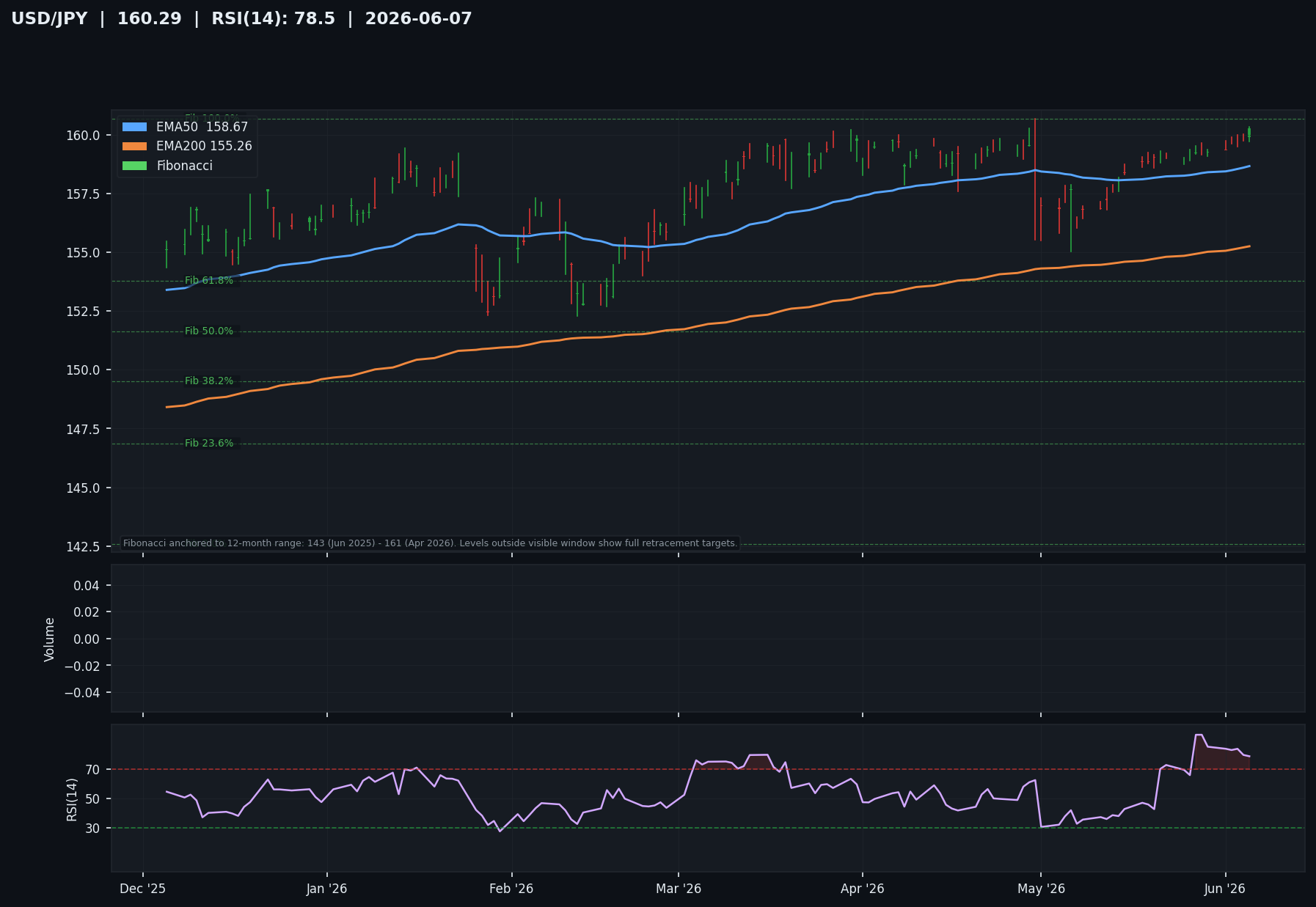
The yen is buckling under pressure once more. At 160.293 against the dollar as of June 7, USD/JPY sits just a fraction beneath its twelve-month high of 160.702, a level that has etched itself into the collective memory of currency traders as the threshold where Tokyo’s patience historically snaps. The pair has gained 2.4 per cent over the past month alone, extending a relentless year-to-date advance of more than 12 per cent that has left the Japanese currency languishing near its weakest levels in decades. What makes this particular juncture so consequential is not simply the altitude of the exchange rate but the volatile convergence of forces — monetary policy divergence that refuses to narrow, a US economy that continues to defy expectations of slowdown, and a Japanese Ministry of Finance whose intervention playbook is being tested once again by markets that seem determined to call its bluff.
The fundamental architecture supporting dollar-yen strength remains stubbornly intact. The Federal Reserve, having paused its easing cycle earlier this year after delivering only modest rate cuts in late 2025, continues to hold the fed funds rate at a level that preserves a yawning interest rate differential with Japan. Recent US economic data has reinforced the case for patience in Washington: the labour market, while cooling at the margins, has shown no signs of the kind of deterioration that would force the Fed’s hand, and core inflation readings remain sticky enough to keep policymakers cautious about delivering further accommodation. This week’s ISM services print came in above consensus, while Friday’s payrolls report offered another reminder that the American economy is not cooperating with those who had pencilled in aggressive easing. The result is that US two-year Treasury yields continue to hover well above their Japanese equivalents, keeping carry trade dynamics firmly tilted in favour of being long the dollar and short the yen. For institutional investors running yield-harvesting strategies, the arithmetic remains compelling, even as the exchange rate stretches into territory fraught with intervention risk.
On the Japanese side, the Bank of Japan finds itself trapped in a credibility bind. Governor Ueda’s tentative steps toward policy normalisation — the end of yield curve control and the incremental rate increases that began in early 2024 — have failed to generate the kind of sustained yen appreciation that Tokyo had hoped for. The BOJ’s overnight rate, even after multiple hikes, remains extraordinarily low by global standards, and the forward guidance has been carefully hedged with language about data dependency and the need to confirm a virtuous cycle of wages and prices. Markets have taken this caution as a signal that any further tightening will be glacial in pace. Meanwhile, the political dimension cannot be ignored. The 160 level has historically served as a de facto line in the sand for the Ministry of Finance, which authorised massive intervention operations in 2022 and again in 2024 when the yen weakened past this threshold. Vice Finance Minister for International Affairs and his team have already escalated their verbal rhetoric in recent sessions, deploying the familiar lexicon of “speculative moves” and “decisive action,” yet the market’s muted response to these warnings suggests a growing scepticism about whether words will be matched by deeds. The paradox of yen weakness persisting even amid episodic bouts of global risk aversion — moments when the currency’s traditional safe-haven status should theoretically provide support — underscores how powerfully the carry trade narrative has overridden older market reflexes.
The technical picture amplifies the sense of a market approaching a critical inflection. USD/JPY is trading comfortably above both its 50-day exponential moving average, currently at 158.674, and its 200-day EMA at 156.266, confirming a firmly entrenched uptrend across multiple timeframes. The gap between price and the 50-day EMA — roughly 160 pips — is wide but not unprecedented for this pair during sustained trend phases. What demands attention, however, is the relative strength index, which at 78.5 has pushed well into overbought territory. Readings above 70 have historically preceded at least short-term consolidations in this pair, though the caveat is that during powerful trend moves, the RSI can remain elevated for extended periods before a meaningful correction materialises. The Fibonacci retracement framework, anchored to the twelve-month range from the low of 142.587 to the high of 160.702, places the current price at essentially the zero per cent retracement — the top of the range. The first meaningful support on a pullback sits at the 23.6 per cent retracement of 156.427, which conveniently aligns with the vicinity of the 200-day EMA, creating a confluence zone that would likely attract significant buying interest. Deeper support at the 38.2 per cent level of 153.782 would only come into play in a more dramatic unwind scenario, potentially triggered by actual intervention or a sudden shift in Fed rhetoric.
The bullish scenario from here requires a clean break above the 160.702 twelve-month high, which would open a psychological runway toward 162 and potentially the multi-decade peaks near 162.50 that were tested in 2024. Such a move would most plausibly be catalysed by another round of firm US data that pushes Fed rate cut expectations further into the future, or by a BOJ meeting that disappoints hawks. If the pair clears 161 with conviction and daily closes above that level accumulate, the momentum-chasing segment of the speculative community would likely pile in aggressively, creating self-reinforcing upside pressure that could persist until Tokyo’s hand is forced into actual dollar-selling intervention. The bearish scenario, by contrast, centres on the tangible risk that the MOF moves beyond rhetoric to action. Japan holds approximately $1.2 trillion in foreign exchange reserves and has demonstrated a willingness to deploy them decisively when the political calculus demands it. A surprise intervention operation — particularly if coordinated with dovish US commentary or executed during thin liquidity conditions — could trigger a violent squeeze of the heavily crowded long dollar-yen positioning, driving the pair swiftly toward the 156.40-156.30 support cluster where the 23.6 per cent Fibonacci level and the 200-day EMA converge. A secondary trigger for the bearish case would be an unexpected shift in Fed communication, perhaps emerging from speeches by FOMC members in the coming fortnight, that explicitly opens the door to a July or September rate cut, compressing the yield differential that underpins the entire trade.
Looking ahead over the next one to two weeks, the balance of probabilities tilts toward continued upside pressure punctuated by sharp but shallow pullbacks driven by intervention fear. The fundamental yield differential remains too wide and too persistent to expect a sustained reversal absent a genuine policy catalyst from either Washington or Tokyo. Yet the overbought RSI reading and the proximity to the twelve-month high counsel against complacency; this is precisely the environment where positioning becomes overcrowded and the correction, when it arrives, can be vicious. Traders should watch the 160.70 level as the key upside trigger and the 158.60-158.70 zone around the 50-day EMA as the first line of defence on any retreat. The most dangerous outcome for the market — and perhaps the most likely over the near term — is a frustrating range-bound grind between 159 and 161, where every approach toward the highs triggers intervention anxiety and every dip is met by carry-hungry buyers. In that scenario, it is the options market, where implied volatility has already begun to rise, that may offer the most honest assessment of the risks that lie beneath the surface calm.
Source and Copyright: Traders’ Leadership Council, 2026. Strictly no trading advice.